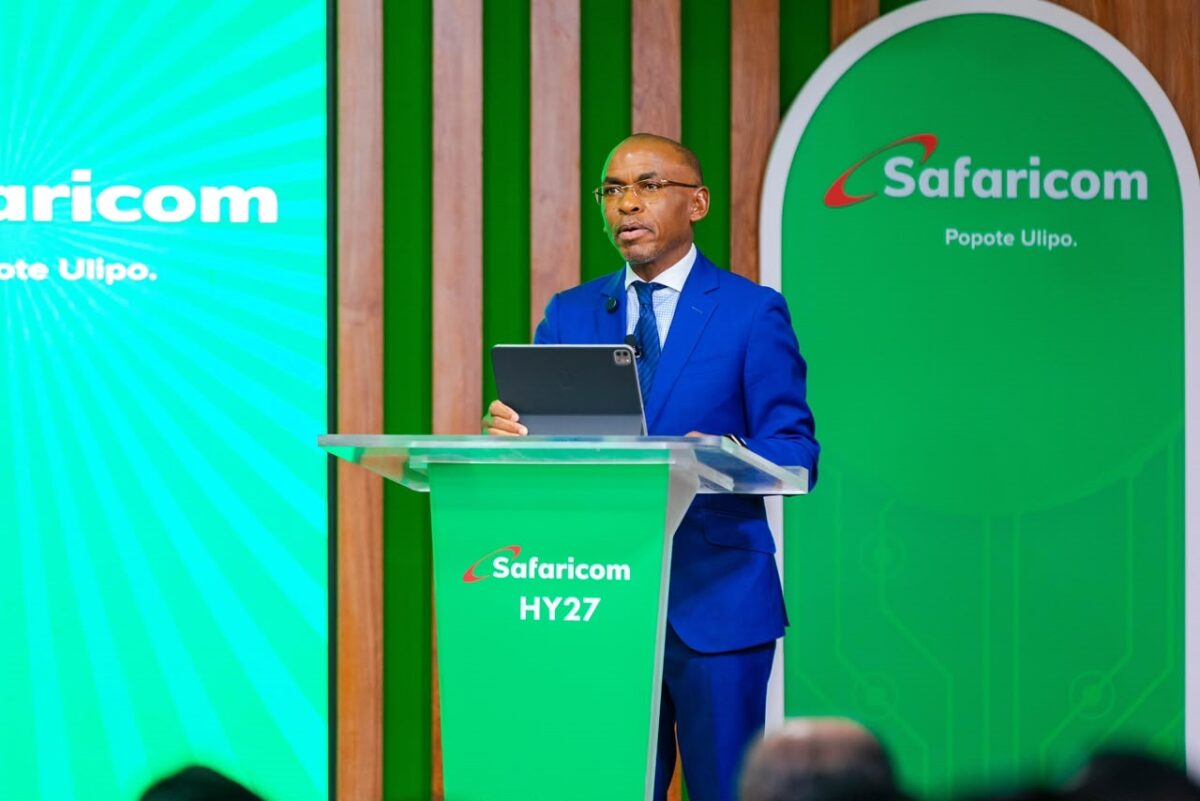
Safaricom PLC Chief Executive Dr. Peter Ndegwa.
By Margaret Wanjiku
Safaricom has reported a 35.9 per cent rise in net income excluding minority interest to
KSh58.15 billion for the six months to September 30, 2026, as strong growth in Kenyan
mobile money and data revenue combined with a dramatic narrowing of losses at its
Ethiopian subsidiary.
The results, announced on Thursday, compare with KSh42.78 billion in the same period
a year earlier. Earnings per share rose to KSh1.45 from KSh1.07.
The headline number was flattered by an accounting effect at group level: profit
attributable to equity holders of the parent rose even as total group profit after
tax—which includes losses borne by minority partners in Ethiopia—climbed 72.5 per
cent to KSh50.35 billion.
Safaricom Ethiopia’s Losses Shrink
The single largest swing factor was Safaricom Telecommunications Ethiopia, where
earnings before interest, tax, depreciation and amortisation improved from a loss of
KSh12.56 billion to a loss of just KSh434.4 million—a 96.5 per cent reduction.
Ethiopian service revenue grew 71.6 per cent to KSh10.62 billion, driven by mobile
data, which rose 90.2 per cent to KSh7.85 billion and now accounts for 74 per cent of
the unit’s service revenue. One-month active customers grew 43.4 per cent to 12.2
million, and average data consumption per subscriber rose 14.8 per cent to 7.72GB.
The improvement in EBITDA was also helped by a sharp fall in net foreign exchange
losses within other operating expenses, from KSh9.39 billion to KSh1.07 billion,
reflecting a more stable birr, which depreciated 4.3 per cent against the dollar in the
period to 163.39.
Group CEO Peter Ndegwa said stronger customer demand, increased network
utilisation and improving operational execution were “translating into better operating
leverage and reinforcing our confidence in the long-term opportunity.”
The Ethiopian business remains lossmaking below the EBITDA line: depreciation and
amortisation of KSh10.92 billion and net finance costs of KSh4.92 billion pushed it to an
operating loss of KSh11.35 billion and a post-tax loss of KSh16.6 billion. But the
trajectory is now the central question for investors.
Kenya Market Delivers the Cash
Safaricom’s Kenyan business remains the group’s profit engine. Safaricom Kenya’s net
income rose 13.8 per cent to KSh66.27 billion, comfortably covering the Ethiopian loss
at group level.
Kenyan service revenue grew 11.3 per cent to KSh215.96 billion. M-PESA revenue rose
13.6 per cent to KSh100.07 billion, contributing 54.7 per cent of the growth, while
connectivity revenue grew 7.7 per cent to KSh103.38 billion and fixed service and IoT
revenue rose 25.5 per cent to KSh12.51 billion.
Within M-PESA, the merchant ecosystem expanded rapidly: the merchant base grew
90.3 per cent to 4.51 million, Pochi customers rose 115.3 per cent to 3.23 million, and
wealth management assets under management jumped 69.7 per cent to KSh25.56
billion. Chargeable transactions per one-month active customer rose 31.5 per cent to
50.89.
Mobile data revenue in Kenya grew 12.2 per cent to KSh45.24 billion, with 4G+ devices
up 33.5 per cent to 34.3 million and average usage per chargeable subscriber up 9.4
per cent to 5.31GB. Voice revenue grew 6.2 per cent to KSh42.20 billion.
Kenyan EBITDA rose 13.3 per cent to KSh128.94 billion, and operating free cash flow
climbed 19.6 per cent to KSh85.31 billion.
At group level, service revenue rose 13.1 per cent to KSh226.06 billion, and total
revenue 14.2 per cent to KSh233.68 billion. EBITDA grew 27.5 per cent to KSh129.18
billion, lifting the margin from 49.5 per cent to 55.3 per cent. EBIT rose 39.8 per cent to
KSh91.14 billion.
The margin expansion owes much to Ethiopia: group other operating expenses fell 11.1
per cent to KSh44.54 billion, largely because of the smaller foreign exchange losses in
the Ethiopian unit. Excluding the currency effect, cost growth was more modest.
Group net finance costs were broadly flat at KSh9.91 billion, while the tax charge rose
18.9 per cent to KSh30.98 billion.
On a constant-currency basis, the group said service revenue grew 13.6 per cent, EBIT
33.6 per cent and net income excluding minority interest 30.0 per cent—a reminder that
reported growth is partly a function of exchange-rate translation, with the birr conversion
rate moving from 0.9553 to 0.8088 to the shilling.
Cash Generation and a New Spectrum Licence
Net cash generated from operating activities rose to KSh91.92 billion from KSh64.74
billion. Capital expenditure on property and equipment was KSh40.27 billion, down
slightly, while acquisition of intangible assets rose to KSh14.51 billion.
That increase reflects a 25-year spectrum licence renewal granted by the Kenyan
government effective July 1, 2026, recognised as an intangible asset at the present
value of contractual cash flows. Group net debt widened to KSh193.39 billion from
KSh139.81 billion at the March year-end, reflecting the new licence obligation and
higher borrowings.
The company paid dividends of KSh45.56 billion during the period, versus KSh26.33
billion a year earlier.
CEO Ndegwa said the second half would focus on “protecting and growing connectivity
and payments, scaling merchant and financial-services propositions, accelerating fixed
and enterprise technology solutions and maintaining execution discipline in Ethiopia.”
The central issue for the market is whether Ethiopia can complete its journey to EBITDA
break-even and then to profitability. Management cautioned that the pace “will continue
to depend partly on pricing implementation, foreign exchange conditions and disciplined
execution.”
The balance sheet also carries the unresolved Vodacom–Government of Kenya
transaction, announced in December 2025, under which Vodacom agreed to increase
its effective interest in Safaricom by 20 per cent. The company pointed shareholders to
Vodacom’s most recent regulatory update on the deal.
(1USD=KSh130)